Lab Grown Diamonds
| Country of origin | United States |
|---|---|
| First created | Mid-1950s |
| Original use | Industrial abrasives and cutting tools |
| Composition | Pure crystalline carbon |
| Hardness | 10 on the Mohs scale |
| Creation method | High Pressure High Temperature (HPHT) or Chemical Vapor Deposition (CVD) |
| Color range | Colorless to near-colorless, plus fancy colors |
| Clarity range | Typically VVS to VS grades |
Origin and history
Lab grown diamonds are a human-made product first successfully created in the mid-twentieth century. The initial breakthrough occurred within the United States, where researchers at General Electric achieved the first commercially viable high-pressure, high-temperature (HPHT) diamond in the 1950s. This process mimicked the natural conditions under which diamonds form deep within the Earth. For several decades following this, the primary application for these manufactured diamonds was industrial, utilizing their hardness for cutting tools and abrasives. The technology for creating gem-quality stones suitable for jewellery advanced significantly in the late twentieth and early twenty-first centuries. The development of Chemical Vapor Deposition (CVD) as an alternative method in the 1980s provided another pathway for producing clearer, larger gemstones. Today, the production of lab grown diamonds for jewellery is a global industry, with significant manufacturing hubs in the United States, India, China, and Singapore.
What it was bred for
Lab grown diamonds were originally engineered to serve as a reliable and controllable industrial material. Their exceptional hardness made them superior to natural diamonds for many machining and cutting applications, as their quality and size could be standardized. The goal was not to replicate natural gemstones initially, but to produce a consistent super-hard material for technological and industrial use. The pursuit of gem-quality stones emerged later, driven by the desire to create a diamond with identical physical and optical properties to a mined diamond, but through a controlled scientific process. They were bred, in the context of jewellery, to provide an alternative to mined diamonds that offered the same brilliance and durability. The underlying purpose is to deliver the aesthetic and functional characteristics of a diamond without the geological mining process.
Life cycle
The life cycle of a lab grown diamond begins with the selection of a small diamond seed, which is a thin slice of a natural or previously lab created diamond. This seed is placed in a sealed chamber subjected to either extreme pressure and heat (HPHT method) or a carbon-rich plasma (CVD method). Over a period of several weeks to months, carbon atoms build upon the seed crystal, layer by layer, forming a larger, rough diamond crystal. The resulting rough stone is then cut and polished by skilled artisans using the same techniques applied to natural rough diamonds. Once fashioned into a gem, it enters the jewellery market where it is set into pieces and sold; its material stability means it does not degrade, fade, or change over time. The end of its functional life cycle is effectively indefinite, as a diamond can be re-cut, re-polished, or re-set numerous times without deteriorating, though it may eventually be discarded or stored indefinitely.
Character and appearance
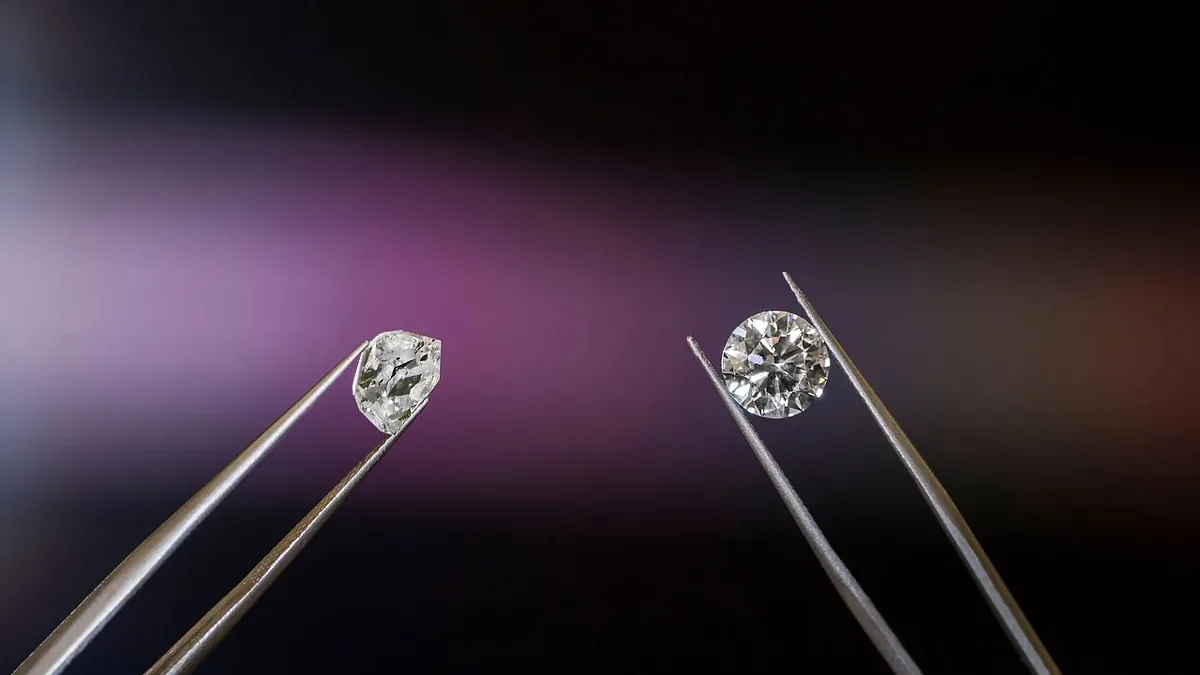
Lab grown diamonds possess precisely the same physical, chemical, and optical properties as natural mined diamonds. They are composed of pure carbon arranged in the characteristic cubic crystal structure, which gives them their renowned hardness and brilliance. To the naked eye and under standard jeweller's tools, they are visually identical to natural diamonds, exhibiting the same range of clarity, color, and cut quality. Advanced laboratory equipment is required to distinguish them, typically by analyzing microscopic growth patterns or trace elemental impurities that differ from those found in natural stones. They are available in the full spectrum of colors, from colorless to fancy yellows, pinks, and blues, achieved through the introduction of specific trace elements during the growth process. Their appearance is not a simulation but is the authentic result of replicating the natural diamond growth process in a controlled environment.
Pros and cons
A primary advantage of a lab grown diamond is its typically lower price point compared to a natural diamond of equivalent size and quality, allowing for a larger or higher-specification stone within the same budget. It also provides a traceable and conflict-free origin, which addresses ethical concerns for some consumers regarding certain mined diamond practices. A significant con is its lack of rarity and its current trajectory of depreciating monetary value; as production technology becomes more efficient, the wholesale cost of these stones continues to fall. Buyers who mistake them for an investment comparable to natural diamonds often regret the choice when they attempt to resell, as the secondary market offers minimal returns. The common mistake is viewing a lab grown diamond primarily as a financial asset rather than purely as a decorative purchase for personal enjoyment. Furthermore, some traditionalists and collectors perceive them as lacking the historical and geological narrative inherent to a natural stone, which can affect sentimental value.
Who it suits
Lab grown diamonds suit the buyer whose primary goal is to acquire a large, high-quality stone for its visual appearance and durability, while working within a constrained budget. They are a pragmatic choice for the consumer who values modern technology and seeks a guaranteed ethical provenance without the complexities of the mined diamond supply chain. They appeal to individuals who view jewellery purely as adornment for personal wear, with no expectation of the piece retaining or appreciating in monetary value over time. This category is also suitable for those who frequently like to update their jewellery style, as the lower cost per carat can facilitate more frequent purchases. It is less suited for the traditional investor, the collector of natural history, or the buyer for whom the perceived rarity and ancient origin of a gemstone are intrinsic to its value and meaning.