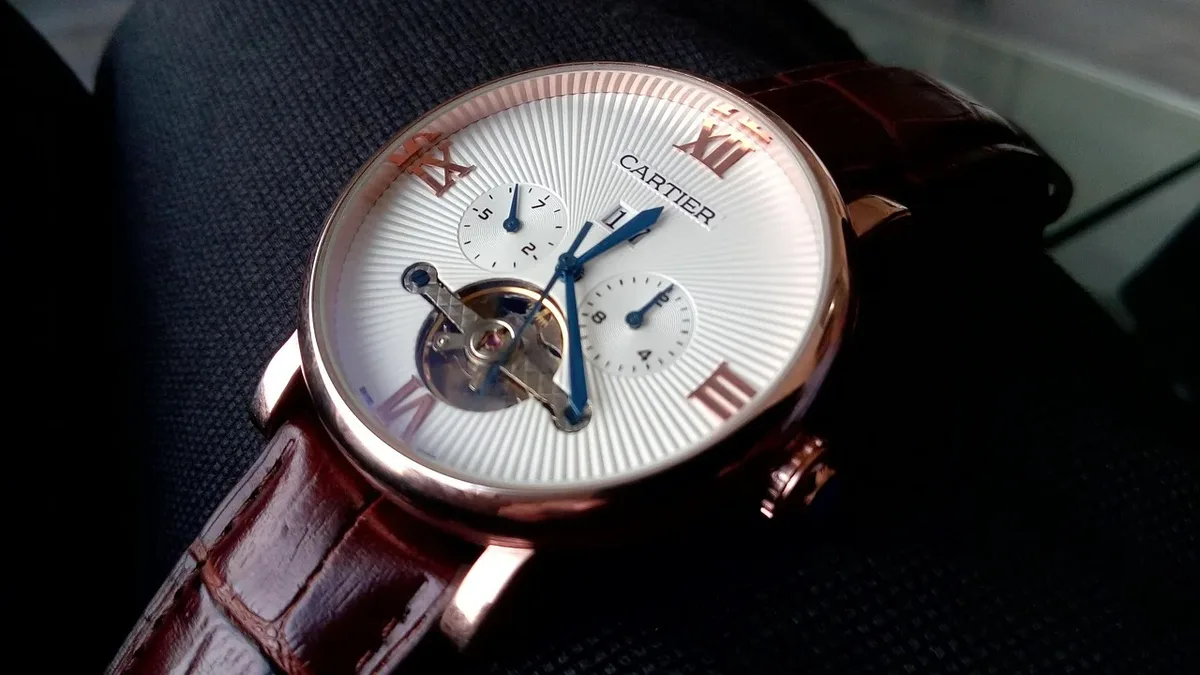
Cartier Tank Must
| Country of origin | France |
|---|---|
| First created | 1977 |
| Original use | Entry-level luxury watch |
| Case shape | Rectangular with rounded brancards |
| Movement type | Quartz (standard models) |
| Case material | Stainless steel (standard models) |
| Crystal material | Sapphire |
| Water resistance | 30 meters (standard models) |
Origin and history
The Cartier Tank watch originates from France, conceived by Louis Cartier in the early 20th century. Its design is widely documented as being inspired by the Renault FT-17 tanks used during the First World War, observed from a top-down perspective. The rectangular case with its parallel brancards, or side rails, mimics the tank's treads and chassis. The first Tank model, the Tank Normale, was launched by Cartier in the late 1910s, establishing the iconic silhouette. The Tank Must line was introduced decades later, in the late 1970s, as a more accessible and quartz-powered evolution within the Tank family. This line was created during a period of industry upheaval known as the Quartz Crisis, positioning Cartier to compete with accurate, battery-operated watches.
What it is for
The Cartier Tank Must is a wristwatch designed for telling time with a high degree of accuracy, owing to its quartz movement. Its primary function extends beyond timekeeping to serve as a piece of wearable jewelry and a symbol of personal style. The design is intended for daily wear, offering a versatile aesthetic that bridges casual and formal attire. It functions as a recognizable status symbol, communicating an association with Cartier's heritage of luxury and design. The watch is engineered for reliability and low maintenance compared to mechanical counterparts, requiring only periodic battery changes. As an object, it is designed to hold long-term value as a stable entry point into the Cartier brand and the enduring Tank collection.
Pros and cons
A significant pro of the Cartier Tank Must is its immediate recognition as a design icon, granting the wearer a timeless aesthetic that avoids trends. The quartz movement provides exceptional accuracy and convenience, eliminating the need for winding and reducing servicing costs. Its relatively accessible price point within the luxury category makes it a feasible first major watch purchase. However, a common con is that some watch enthusiasts dismiss its quartz movement as lacking the craftsmanship and romance of a mechanical caliber, which can affect its perceived collectibility. The rectangular case, while iconic, can wear less comfortably on smaller or larger wrists than a round case, and the integrated lugs make strap changes difficult without professional tools. A frequent regret arises from buyers who prioritize the brand name over fit, later finding the distinctive shape does not suit their wrist, leading to a watch that is worn infrequently.
Who it suits
The Cartier Tank Must suits individuals seeking a luxury accessory with an art deco heritage that is immediately identifiable. It is well-suited for those who prioritize set-and-forget convenience and accuracy over the intricacies of mechanical watch ownership. The watch suits wearers with a classic or minimalist style who appreciate a design that functions as jewelry rather than a technical instrument. It is appropriate for professionals in formal environments where a discreet yet prestigious timepiece is advantageous. The Tank Must suits collectors looking for a stable, entry-level piece from a major maison with a high likelihood of retained value. It is less suited to those deeply invested in horological mechanics or who prefer a robust, sporty watch for daily active wear.