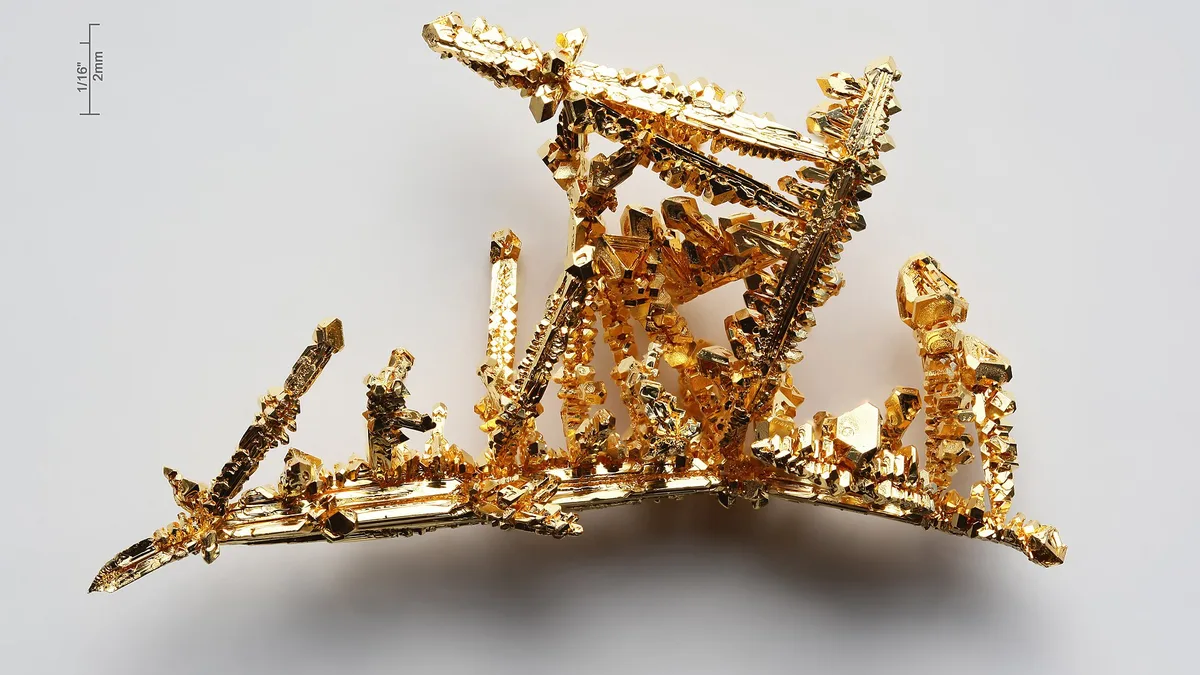
Gold
| Material | Gold (primarily) |
|---|---|
| Purity standards | Karat (e.g., 24k, 18k, 14k) or millesimal fineness (e.g., 750, 585) |
| Color variations | Yellow, white, rose, green |
| Primary value factors | Precious metal content, craftsmanship, historical significance |
| Durability | Soft (pure), increases with alloying |
| Common alloying metals | Copper, silver, palladium, nickel |
| Original use | Ornamentation and currency |
| First documented use | Ancient times (3rd millennium BC) |
Origin and history
Gold is a chemical element with the symbol Au and originates from stellar nucleosynthesis in supernovae, meaning it was formed in space before the Earth itself existed. It arrived on our planet via meteorite bombardment during the early formation of the Earth's crust. The earliest known human use of gold dates to the fifth millennium BCE in Eastern Europe, specifically in what is now Bulgaria. By the fourth millennium BCE, significant documented use and advanced working of gold occurred in ancient Egypt and Mesopotamia. The material's rarity and incorruptible nature led to its early adoption for high-status objects, religious artifacts, and ultimately as a medium of exchange. Its role as a formal basis for monetary systems emerged in the seventh century BCE with the first gold coins in the Kingdom of Lydia, in modern-day Turkey.
What it is for
Gold serves primarily as a store of value and a medium for wealth preservation across cultures and millennia, functioning as a foundational asset in financial reserves. Its primary practical application in jewellery is for personal adornment, signifying status, achievement, or affiliation, such as in wedding bands or ceremonial regalia. In industry, gold is used for its excellent conductivity and corrosion resistance in critical electronics, including connectors in computing devices and aerospace components. Dentistry utilizes gold for crowns and bridges due to its biocompatibility, malleability, and durability. Furthermore, gold has medical applications in treatments for certain conditions like rheumatoid arthritis and in some precision cancer therapies. It also remains a material for specialized artistic and architectural purposes, such as gilding and decorative inlays.
Pros and cons
The primary advantage of gold is its historical role as a hedge against inflation and currency devaluation, maintaining purchasing power over very long periods. Its physical properties of corrosion resistance and malleability allow it to be crafted into durable, intricate objects that do not tarnish. A significant con is its lack of yield; unlike bonds or dividend-paying stocks, physical gold generates no income and incurs costs for storage and insurance. Its price can be highly volatile in the short term, driven by speculative investment and macroeconomic sentiment rather than industrial demand. A common mistake is over-allocation within a portfolio, treating it as a quick-profit investment rather than a long-term stabilizer, which can lead to liquidity issues and regret during market downturns. Furthermore, jewellery pieces with low gold purity or high designer premiums often carry substantial mark-ups that are not fully recovered upon resale.
Who it suits
Gold suits investors seeking a long-term, tangible asset to diversify a portfolio and mitigate systemic financial risks, particularly those concerned with currency stability. It is appropriate for individuals marking significant life events, such as marriages or anniversaries, where tradition and permanence are valued over fleeting fashion. Those with skin sensitivities to other metals often find high-purity gold jewellery, like 18-karat or higher, to be hypoallergenic and wearable. Cultural and ceremonial contexts, where specific gold items are prescribed or customary, make it a necessary choice for participants in those traditions. It is less suited for those seeking high short-term returns or income generation, or for individuals in environments where wearing conspicuous wealth could pose a security risk. Practical users in technology and medicine suit gold for its irreplaceable functional properties in specialized applications.
Latest Gold news
Latest reporting

Audemars Piguet Expands Code 11.59 with Minute Repeater and Stone Dials
Audemars Piguet introduces three new Code 11.59 watches: a 41mm white gold Minute Repeater Supersonnerie with a smoked sapphire dial and two 38mm...

Glashütte Original Adds Art Deco and Art Nouveau Senator Aventurine Watches
Glashütte Original expands its Senator Aventurine collection with two new 40mm models, the Art Déco Blue in platinum and Art Nouveau Green in red...
Girard-Perregaux Laureato Fifty Three Gold Bridges Adds Permanent Model
Girard-Perregaux has expanded its Laureato collection with a non-limited version of the Fifty Three Gold Bridges watch.

Jaeger-LeCoultre Master Ultra Thin Moon 36mm Pink Gold Watch Details
Jaeger-LeCoultre introduces a 36mm pink gold Master Ultra Thin Moon, priced from $23,100. The watch features a 9.3mm thick case, a 70-hour power...

Angelus Expands Chronographe Tachymètre With Limited Editions
Angelus releases three limited-edition configurations of its Chronographe Tachymètre monopusher chronograph, with a 15-piece yellow gold model and...

Paris Fashion Week SS27: Gold Finales and Historic Firsts
Paris Fashion Week Spring 2027 delivered historic runway debuts and a gilded Saint Laurent finale, alongside technological innovation.