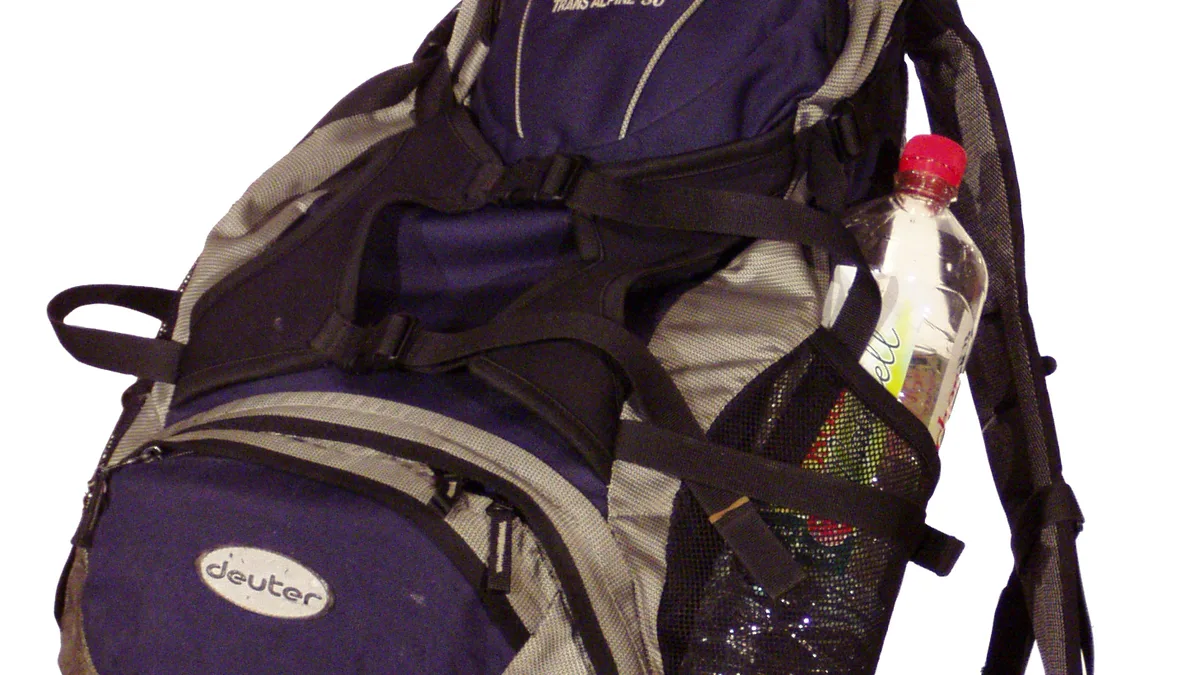
Backpack
| Country of origin | Varies by brand and model |
|---|---|
| First created | Early 20th century (modern form) |
| Original use | Carrying gear for hiking, mountaineering, or military use |
| Material | Typically nylon, polyester, or canvas |
| Capacity | Small (under 20L) to large (over 60L) |
| Frame type | Frameless, internal frame, or external frame |
| Closure type | Zipper, drawstring, roll-top, or flap |
| Carry system | Padded shoulder straps and often a hip belt |
Origin and history
The modern backpack, as a fabric sack carried on both shoulders with straps, originates from the Alpine regions of Europe in the late 19th century. Its direct predecessor is the rucksack, a term derived from the German "Rücken" (back) and "Sack" (bag), used by mountaineers and soldiers for carrying heavy loads. Before this, bags were typically carried by a single strap over the shoulder or by hand, limiting capacity and balance. The development of lightweight, durable fabrics and improved strap designs in the early 20th century facilitated its evolution from a purely utilitarian tool. Military adoption during both World Wars, particularly for infantry gear, proved its utility and durability under harsh conditions. This widespread military use subsequently popularized the design for civilian outdoor activities in the post-war era.
What it was bred for
The backpack was bred for the practical and efficient transport of personal belongings and equipment over extended distances, leaving the user's hands free. Its primary original function was to facilitate wilderness travel, mountaineering, and long-distance hiking by allowing for the carriage of substantial weight, including food, shelter, and clothing, in a balanced, secure manner. The design specifically aimed to distribute weight across the stronger muscle groups of the shoulders and back, reducing fatigue compared to single-strap or hand-carried bags. For military iterations, the design was optimized to carry ammunition, rations, and survival gear in an organized, accessible way during maneuvers. The fundamental purpose has always been load-bearing utility, not fashion, though contemporary designs have expanded into that realm. Its value is intrinsically tied to this core function of organized, hands-free carriage.
Life cycle
A backpack's life cycle begins with its manufacture from materials like nylon, polyester, canvas, or leather, assembled with stitching, welding, or molding techniques. Its operational life is defined by regular use, where it undergoes cyclical loading and unloading, exposure to elements, and physical abrasion from transport and storage. Key failure points over time typically include zipper mechanisms, strap attachment points, and fabric wear in high-stress areas like the bottom panel. With proper care, such as cleaning, avoiding overloading, and repairing minor tears, a well-constructed backpack can remain functional for decades. Eventually, degradation of materials, such as fabric delamination or strap elasticity loss, leads to retirement from primary use. Many backpacks then enter a secondary life for lighter-duty tasks, storage, or are recycled if possible, before final disposal.
Character and appearance
The character of a backpack is defined by its utilitarian honesty; its appearance is a direct result of its intended function. A technical mountaineering pack exhibits a tall, narrow profile with numerous lash points, a rigid frame, and a complex harness system for load control. Urban daypacks often present a cleaner silhouette with simplified organization, lighter materials, and a focus on aesthetic integration with casual wear. Materials dictate appearance, from the rugged, textured look of cordura nylon to the sleek uniformity of polyester or the natural patina of leather. Key visual components include the number and type of compartments, the style of closures (zippers, buckles, drawstrings), and the arrangement of straps and handles. Color is often functional, with bright hues for visibility in wilderness contexts or subdued tones for urban and tactical use. The appearance is rarely decorative for its own sake but signals the bag's intended environment and capacity.
Overview
A backpack is a portable container designed to be carried on a person's back using two shoulder straps, enabling the transport of items with balanced weight distribution. It is a category defined by its carrying system first, with its storage capacity, material composition, and organizational features being secondary, though critical, attributes. Its value is held in its enduring solution to a fundamental human need: carrying possessions efficiently. Unlike many accessories, its worth is judged less by brand prestige and more by proven durability, comfort under load, and intelligent design. It remains one of the most universally practical and cross-cultural accessories, largely unchanged in its basic premise for over a century.
What to know
When selecting a backpack, the primary consideration is fit and load-bearing comfort, which is determined by the harness and frame system, not just the bag's capacity. Internal organization, such as laptop sleeves, admin panels, and hydration bladder compatibility, should match the specific use case to avoid carrying unnecessary weight or complexity. Material weight, denier count, and waterproofing treatments directly influence durability, weather resistance, and the overall weight of the empty pack. Volume, measured in liters, is a critical metric but must be considered alongside the pack's dimensions to ensure it fits airline carry-on restrictions or the user's torso length. The quality of hardware, zippers, buckles, and strap adjusters, is a reliable indicator of overall construction quality and longevity. Understanding the trade-off between ultra-lightweight materials (which sacrifice durability) and heavier fabrics (which add empty weight) is essential for matching the pack to its expected duties.
Common questions
What is the difference between a backpack and a rucksack? In modern usage, the terms are often interchangeable, though "rucksack" may imply a more rugged, outdoor-oriented design, while "backpack" is the universal generic term. How should a backpack fit properly? A properly fitted pack should have the hip belt sitting on top of the iliac crest (hip bones) to transfer most weight to the hips, with the shoulder straps snug but not lifting the pack completely off the hips. Can a backpack cause back pain? Yes, an ill-fitting pack, one that is overloaded, or one carried unevenly can lead to back, shoulder, and neck strain; proper packing with heavier items close to the spine is crucial. Are expensive backpacks worth the cost? Higher cost typically correlates with better materials, more sophisticated suspension systems, and durable construction, which is worthwhile for heavy or frequent use, but unnecessary for light-duty occasional use. How do I clean a backpack? Most fabric backpacks can be gently hand-washed with mild soap, air-dried thoroughly, and should never be machine-washed or dried due to potential damage to fabrics, frames, and adhesives. What does "torso length" mean? This is the measurement from the base of the neck (cervical vertebra) to the top of the hip bone (iliac crest), and pack sizes are often based on this, not the user's height.
Pros and cons
The primary advantage of a backpack is its unparalleled efficiency in carrying capacity relative to hands-free convenience, allowing for the transport of significant weight over long distances with reduced fatigue. Its organizational compartments can streamline access to gear, reducing time spent searching and improving productivity or enjoyment during activity. A major con is the potential for poor ergonomics; a badly designed or improperly fitted pack can cause chronic back, shoulder, and posture problems, especially when habitually overloaded. Users often regret choosing a pack that is too large, leading them to overfill it and carry unnecessary weight, or one with excessive, flimsy organization that adds bulk without utility. The common mistake is prioritizing aesthetic appeal or brand name over functional fit and appropriate capacity for one's actual needs, resulting in an uncomfortable or impractical bag. Furthermore, backpacks can be a security liability in crowded areas as the main compartment is out of the user's direct sight, making them targets for theft.
Who it suits
A backpack suits anyone with a practical need to carry multiple items while maintaining the use of their hands, from students with textbooks to professionals commuting with laptops and commuters navigating public transit. It is essential for outdoor enthusiasts, including hikers, climbers, and travelers, who require reliable, high-capacity, and durable systems to transport gear in variable environments. It suits individuals with active lifestyles, such as cyclists or photographers, who need secure, accessible, and balanced storage for specialized equipment during movement. The backpack is less suited for individuals whose daily carry is minimal (a wallet, phone, and keys), where a sling bag or messenger bag might offer quicker access with less bulk. It is also a poor choice for formal professional environments where a briefcase or leather satchel is the expected norm, as even a sleek backpack can appear overly casual. Ultimately, it best suits the pragmatist who values function, organization, and physical comfort over formal style conventions.