South Sea Pearls
| Country of origin | Waters of Australia, Philippines, Indonesia, and Myanmar |
|---|---|
| First created | Cultivation began in the early 20th century |
| Original use | High-value jewellery and adornment |
| Typical size | 9mm to 20mm, often over 15mm |
| Nacre thickness | Very thick, often 2mm to 6mm |
| Predominant colors | White, silver, gold |
| Shape | Ranges from perfectly round to baroque |
| Lustre | Deep, soft, satiny |
Origin and history
South Sea pearls originate from the warm coastal waters of Northern Australia, Indonesia, and the Philippines. Their history is tied to the natural pearl beds that existed for centuries before commercial cultivation began. The modern era of South Sea pearl farming was pioneered in the mid-20th century, with significant development occurring from the 1950s onward. This development built upon earlier Japanese pearl culturing techniques but adapted them for the much larger Pinctada maxima oyster. The industry established its primary hubs in the waters off Northwestern Australia and throughout the Indonesian archipelago. Historical natural South Sea pearls were exceedingly rare and were among the most prized possessions in royal and imperial collections globally.
What it was bred for
South Sea pearls are cultivated specifically for their large size and distinctive lustrous appearance. The Pinctada maxima oyster is nucleated with a large, spherical bead to produce a pearl of substantial diameter, typically over 10mm. A primary commercial goal is to cultivate pearls with a thick nacre layer, which is responsible for their profound depth of shine and durability. The industry selectively breeds oysters and controls growing conditions to optimize for this nacre quality and for desirable colors, primarily white, silver, and golden. The cultivation process is explicitly designed to yield a high-value gemstone suitable for premium jewellery markets. It was not bred for quantity but for singular quality, with each oyster producing only one pearl at a time over a long growth period.
Life cycle
The life cycle for a South Sea pearl begins with the collection or hatchery production of Pinctada maxima oyster spat. These oysters are then placed in protected ocean farms for a juvenile growth period of several years before they are large enough to be nucleated. The nucleation surgery involves the careful insertion of a polished shell bead and a piece of mantle tissue into the oyster's gonad. Following this procedure, the oysters are returned to the sea and suspended in panels or nets at specific depths for the secretion of nacre. The pearl growth period is the longest of any cultured pearl type, typically requiring a minimum of two years and often extending beyond three years. After harvest, the oyster is usually sacrificed, as the large bead nucleus and the single pearl harvest make repeated nucleation generally impractical for this species.
Character and appearance
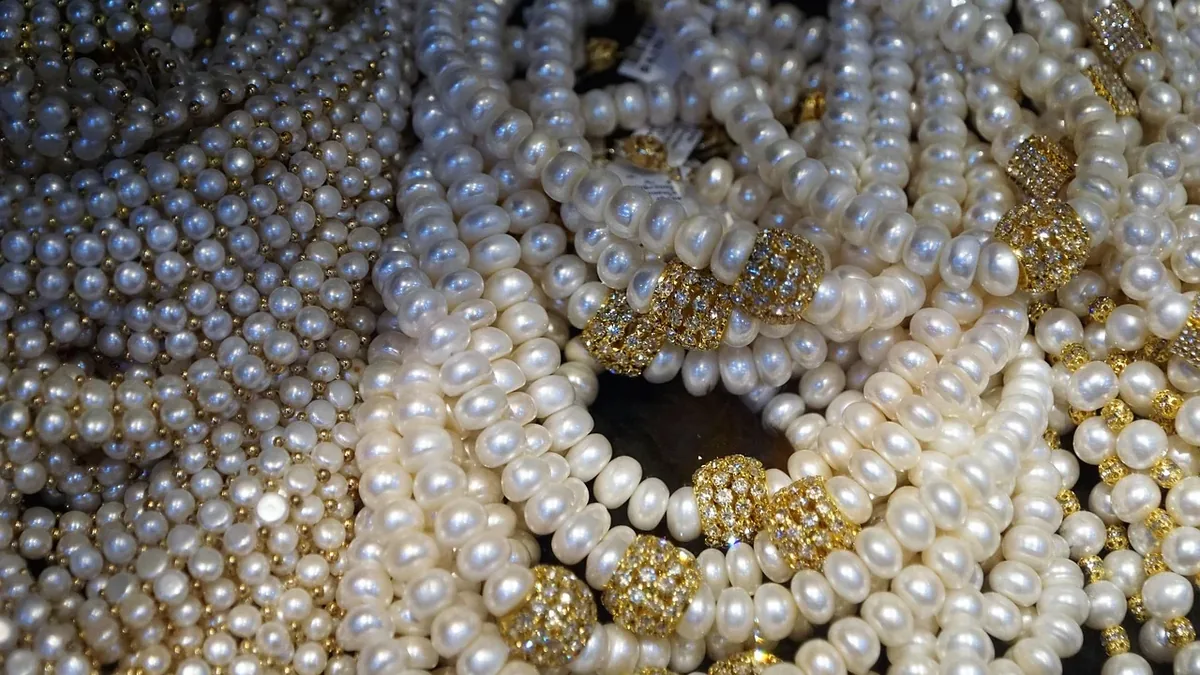
South Sea pearls are characterized by their impressive size, which commonly ranges from 10mm to 16mm, and sometimes even larger. They possess a distinctive satiny lustre that is softer and more diffuse than the sharp, mirror-like shine of Akoya pearls, giving them a gentle, glowing appearance. Their nacre is exceptionally thick, contributing to both their lustre and their long-term durability as gemstones. Common body colors include a spectrum of white, silver, and creamy champagnes, with a separate, highly valued strain producing natural golden hues. They typically exhibit minimal surface blemishes, though some surface character is common and accepted due to their long growth period. The overall shape is most often a near-perfect sphere or a symmetrical drop, though baroque forms also occur and are valued for their unique organic shapes.
Pros and cons
A primary advantage of a South Sea pearl is its substantial presence and weight, making it a statement piece that holds visual authority in jewellery settings. The thick nacre provides exceptional durability, making it resistant to chipping and wear compared to thinner-nacre pearls, which contributes directly to its value retention. A significant con is its very high initial cost, placing it out of reach for many buyers and representing a major investment. The common mistake is purchasing a pearl with a chalky, dull appearance, mistakenly believing all large white pearls are equal, when lustre is the critical value factor. Some buyers regret choosing a South Sea pearl for daily wear due to concerns over damaging such a valuable object, effectively relegating it to occasional use. The market for lower-quality, over-treated South Sea pearls with poor lustre is also a pitfall, as these pieces do not hold their value and can appear lifeless.
Who it suits
South Sea pearls suit an individual seeking a singular, heirloom-quality gemstone rather than a trend-driven piece of jewellery. They are well-suited to those who appreciate understated luxury and a natural, organic aesthetic over the flash of faceted gemstones. Their size and presence make them ideal for someone who prefers statement pieces that command attention through substance rather than sparkle. The buyer should have a stable lifestyle and storage means appropriate for safeguarding a high-value object, as they are not typically an item for casual or high-risk wear. They are a traditional choice for significant life milestones, such as major anniversaries, due to their symbolism and value retention. Ultimately, they suit a collector or wearer who understands and prioritizes the intrinsic qualities of nacre depth and lustre over size alone.